
How we scope a first software release so it actually ships
A first software release should name one user, one outcome, and a clear exclusion list. That is the scoping method we use at JantaraX before we write any code.
Most delayed projects do not fail because the team cannot code. They fail because nobody agreed what “done” means for version one. So we treat the first release as a boundary, not a wishlist. In this guide, we explain the method in plain words, with an example you can copy.
What does scoping a first software release mean
Scoping means deciding what version one will do, and what it will not do. It is not a long document. It is a small set of agreements that everyone can read in two minutes.
A good scope protects your budget, your timeline and your team. It also gives you a fair way to judge a quote. If a new idea appears later, you can check it against the scope instead of arguing about it.
Why most delayed software projects slip
When a project runs late, people often blame the code. But the cause is usually earlier. Nobody wrote down what version one must achieve, so every meeting adds something new. Here are the common patterns.
No shared meaning of done. Everyone has a different picture of the finished product.
A wishlist instead of a boundary. “One more feature” feels cheaper than saying no, so the list keeps growing.
Unclear users. When the app is “for everyone”, nobody’s real problem gets solved well.
Late surprises. Payments, languages or reports appear after the work has started.
Each of these can be fixed in a short conversation before any code is written. That is why we start there.
The four lines that must exist
Before design or architecture, we write four lines with the client. Each line is short, and each one can be checked. If any line is missing, a proposal is marketing, not a plan. Here is how to write each one.
Line 1. Who opens it every week
Name a role, not “users.” A role has a name and a daily routine, such as the store manager, the dispatcher or the sales coordinator.
If you cannot say who opens the app every week, you do not yet know who you are building for. Pick one main person for version one. Other people can come later. A weekly habit is a good test. If someone will not use it every week, it is probably not the core of version one.
Line 2. What job it replaces
Every useful app replaces something that hurts today. It might be a spreadsheet, a chat thread, a notebook or a paper form. Name it. Then you know what the app must do at least as well as the old way. It also tells you what data you already have and where it lives.
Watch the old way for a day and write down every step. Those steps are your first draft of the features.
Line 3. The one outcome version one must produce
This is a single sentence that you can check on a Tuesday morning. It should describe a result, not a feature list.
A weak outcome is “a modern inventory platform.” A strong outcome is “every Monday the owner sees a reorder list built from real stock numbers.” The second one can be tested. Either the list is there and correct, or it is not.
Keep it to one outcome. If you have three, you have three projects. Write it in plain words that your whole team understands. This sentence will guide every demo and every decision.
Line 4. What is explicitly out
An exclusion list is a short list of things version one will not do. It might include payments, a second language, a customer app, or reports nobody asked for.
Write the list down and share it with everyone. It protects the team from scope creep, which means the project grows bit by bit until it never ends. When someone asks for a new item, you can point to the list and decide together. Items on the list are not rejected forever. They are only moved to a later version.
A worked example
Priya runs a two-person spare-parts counter. Stock lives in a notebook. Her brother needs the same numbers when he is at the supplier. Here are her four lines.
Who opens it every week. Priya, and her brother when he visits the supplier.
What job it replaces. The stock notebook.
The one outcome. Item name, quantity, reorder level and a simple received-or-sold entry, so a reorder list is ready each Monday.
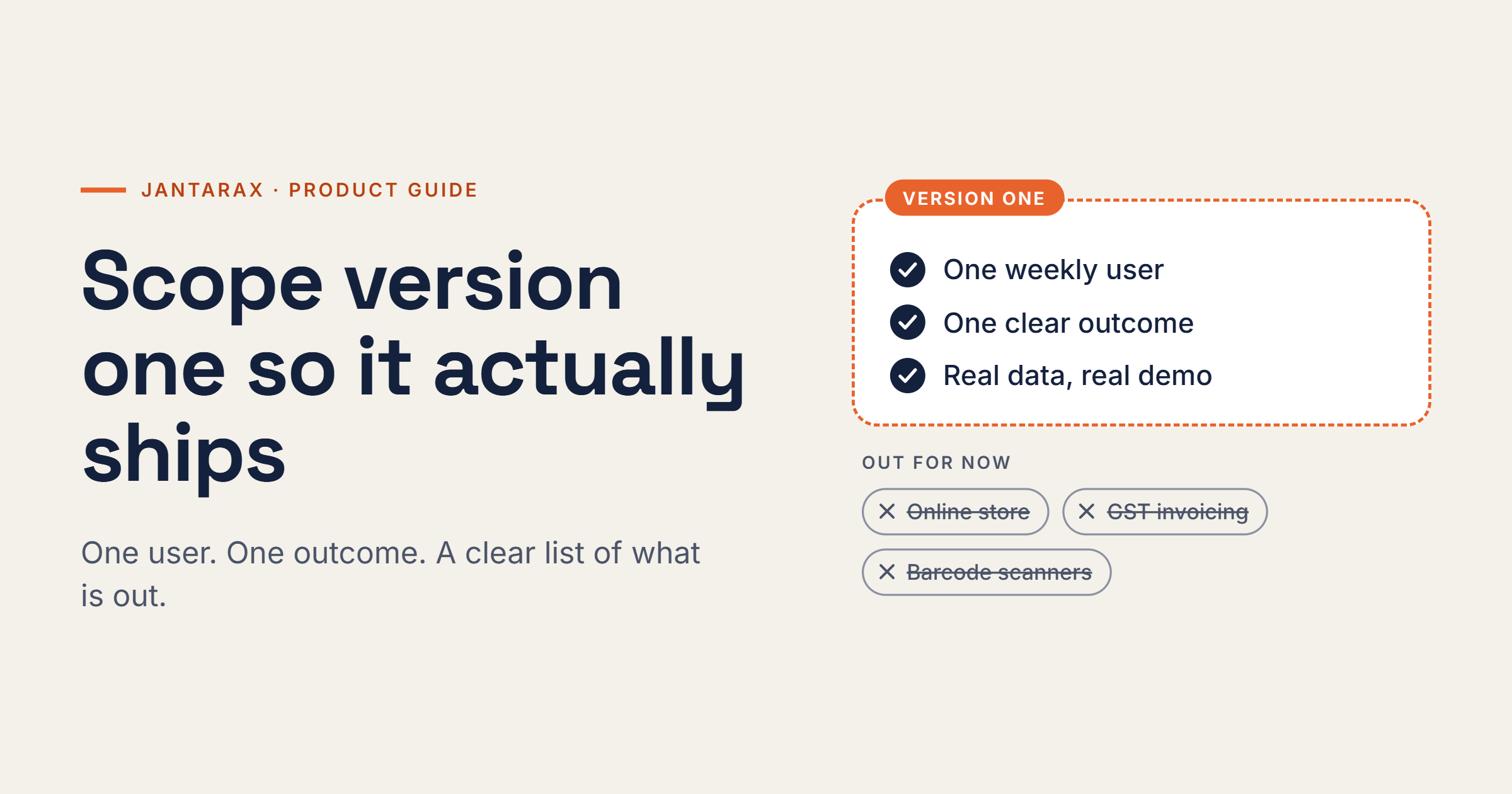
What is out. An online store, GST invoicing and barcode scanners.
That paragraph is enough to start a build. Later, a quote may add a customer app. You can check it against the exclusion list without argument. The customer app is out, so it needs a separate decision and a separate budget.
Notice what happened. The team only had to ask one question. Does this help Priya see the right numbers? If yes, it goes in. If not, it waits. Later, when the first release works, she can add the pieces she left out, one at a time. If she wants automated reordering and barcode scanning, our inventory management software is one place to start.
How to defend your exclusion list
Writing the list is easy. Defending it is harder. Here are three simple habits.
Put it in writing. Add the list to the proposal and the quote.
Check every new request against it. If the item is on the list, it waits for version two.
Price new items separately. A new feature gets its own estimate, so the first release stays on track.
Say no kindly, but say it clearly. A clear no now is cheaper than a late project later.
How demos keep the boundary honest
We schedule demos against the outcome sentence, not against a feature count. A feature count only tells you how many screens exist. The outcome sentence tells you whether the software works.
Take Priya’s example. If the Monday reorder list is empty, the release is not done, even if the screens look finished. That habit stops “almost ready” from lasting months.
Before each demo, ask three questions.
Can the main user do the one job?
Is the data real, not sample data?
Does the outcome sentence pass today?
If the answer is no, the team fixes that first. New ideas go on a list for later. Demos also build trust, because you see real progress early and there are no surprises at launch.
Ownership before launch
Domain, hosting billing and source access should sit with the company, even when we operate the stack. A launch nobody can renew is not finished. We document credentials and handovers as part of the release, not as an afterthought.
Before launch, check that:
The domain is registered in the company’s name.
Hosting bills go to the company, not to a freelancer or vendor.
The company has access to the source code.
Credentials are written down and stored safely.
Someone inside the company knows how to renew each service.
If any of these is missing, the launch is not finished yet.
What happens after version one
Once version one works, you can plan version two. Collect feedback from the person who opens the app every week. Then review the exclusion list. Pick the item that would help most, write its outcome sentence, and scope it the same way. Each release stays small and clear, and the product grows on real needs instead of guesses.
Advantages of a tight first release
Faster feedback from real users. A small release reaches real people sooner, so you learn what works.
Clearer quotes and fewer disputes. The scope is written down, so everyone knows what the price covers.
Room to add only what earns its place. Every new feature has to prove its value first.
A tight first release is not a smaller dream. It is a faster way to reach the bigger one.
Trade-offs to plan for
A tight scope has costs too. It is better to know them early.
Some stakeholders will want everything in version one. Listen to them, record their ideas, and place them in version two.
You must defend the exclusion list in writing. This takes discipline, but it saves time later.
Marketing pages and internal tools should not share one vague “platform” budget. Give each its own scope and its own cost, so one cannot quietly eat the other.
These trade-offs are real, but they are smaller than the cost of a project that never ships.
Who this is for
This method is for owners who are about to hire a team. It is also for teams that keep expanding scope because “one more feature” feels cheaper than saying no.
If you want help writing the four lines, use the project brief tool or read how to brief a software project. If you already know what you need, our web development and mobile app development teams can help you build it.
A simple checklist before you hire a team
Use this list before you sign anything.
I can name the one person who opens the app every week.
I know the spreadsheet, chat or paper form it replaces.
I can write the version one outcome in one sentence.
I have a written list of what is out.
I know who will own the domain, hosting and source code.
I know how the team will show progress.
If you can tick all six, you are ready for a useful quote.
Frequently asked questions
What is a first software release?
It is the first working version that real people use. It does one main job well and leaves other ideas for later. Some teams call it an MVP.
How long should version one take?
It depends on the scope. A smaller, tighter release can launch sooner than a large one.
What should an exclusion list include?
Anything you could be tempted to add but do not need yet, such as payments, a second language, a customer app or extra reports.
How do I stop scope creep?
Write the scope down, check each request against it, and price new items separately.
Who should own the domain and hosting?
The company should own them, even when a vendor runs the technical work. This way you can renew, move or change providers without asking for permission.
Can you help me write the four lines?
Yes. Use our project brief tool or contact us.
Final thoughts
A first release ships when everyone agrees what it must do and what it will not do. Write four lines, name one user, one outcome and a clear exclusion list, and test every demo against the outcome sentence. Keep ownership with your company from day one.
Ready to scope your first release? Book a free consultation with JantaraX. Tell us who will use it, what it replaces, and what must be true on Tuesday morning.
Written by Er. Jatin Varshney, Founder & Managing Director, JantaraX Global IT Private Limited.